

SSL Certificate, One Year On
September 23rd, 2019
by Gwyn Headley
Managing Director
fotoLibra users will have noticed the site has been difficult to reach over the past few days, peppered with warnings that This Is An Insecure Site.
It’s because we didn’t have an SSL Certificate. SSL stands for Secure Sockets Layer, and is a digital code to prove that we are who we say we are on line. It costs about £100 a year. We bought ours from a company called 123-Reg.
They sent me a questionnaire to ask what I thought of their service. Here’s how I replied:
To Ben Law
123-Reg Brand Director
Hello Ben
Are you sure you want to read this? It’s not very complimentary. But then I’ve never had such bad service from a company in my working life.
We bought a two year SSL Certificate from you in September 2017.
In August 2018 you summarily revoked it, and our website was down for five days. No reason was given and no admission of guilt was made. The certificate was stealthily renewed after five days.
In order to prevent this happening again, I contacted you on August 16th 2019 to get our SSL, which was due to expire on September 13th, sorted long before I went on holiday on September 1st.
It happened again.
Here is my increasingly desperate correspondence with 123-Reg, attempting to renew or replace our SSL Certificate.
I have removed your boilerplate “If there’s anything else at all I can do for you please let me know and I’ll be very happy to help” from the following correspondence as it’s not true, and is intensely irritating,
Also the slogan ‘We Make It Easy’ appears on your home page. After reading through this correspondence, please tell me if you honestly believe that to be a valid claim.
AUGUST 16th
Gwyn to 123-Reg
gwyn.headley
16.8.2019. 12:51
We received the following email from you.“Don’t risk losing your services (www.fotoLibra.com)
Gwyn,
The product(s) listed below are due for renewal. We’ll attempt to take payment from your PayPal account on or around 30/08/2019 to ensure the continuation of your service. You can view and update your payment settings here.
Organisational SSL www.fotolibra.com £191.98 two years
SSL certificates need to be renewed 14 days in advance of their expiry date in order to avoid interruption of your service. An SSL renewal goes through the same process as the original SSL setup, so we urge that you log in upon renewal and confirm that all settings are correct.”We bought a two year organisational SSL from you in September 2017, which will expire in September 2019. In August 2018 you mistakenly revoked this SSL, with the result that our company was off line for five days through your error.
We do not want this to happen again this year. I have logged into 123-Reg and ensured that I have two active payment methods set up for you. We would like you to deliver our renewed SSL certificate as soon as possible to avoid the inevitable complications.
Also, when we click on our SSL Overview on your ‘Dashboard’ we read
www.fotolibra.com Organisational SSL Expired 13/09/2019
If the renewal date is not due until 13/09/2019, how has it expired?AUGUST 17th
Mihai-Marian
17.8.2019. 23:34
Hi Gwyn,
Thank you for bringing this to our attention.
I’ve made a few checks on the Organisational SSL certificate assigned to www.fotolibra.com and in our systems this shows as revoked, however, I’ve checked the status of the SSL certificate with our Certificate Authority and in their records, the SSL certificate shows as active until the 13th of September 2019.
Also, to double-check this, I ran a test here: https://www.ssllabs.com/ssltest/analyze.html?d=www.fotolibra.com
It may be best that in this specific situation to purchase a new SSL certificate and apply this to www.fotolibra.com
You can purchase the SSL certificate from https://www.123-reg.co.uk/ssl-certificates/ and apply it to your domain as per https://www.123-reg.co.uk/support/ssl-certificates/how-do-i-apply-an-ssl-certificate/.
Here https://www.123-reg.co.uk/voucher-codes/ you can find a voucher code for a discount on a new SSL certificate.
Please accept our apologies for any inconvenience this may have caused you.
Kind Regards,
Mihai-Marian
123 RegAUGUST 20th
gwyn.headley
20.8.2019. 10:10
Thank you. How can your system possibly show our SSL Certificate as revoked when by your own admission it isn’t?
Gwyngwyn.headley
20.8.2019. 10:30
Thank you for the voucher code for the discount on renewing our SSL Certificate with you. On reading the small print it says “This offer shall expire on 31st January 2019.” Can you send us an update please?
GwynDanny
20.8.2019. 11:01
Hi Gwyn,
On the page https://www.123-reg.co.uk/voucher-codes/ it says that the voucher code will expire on the 1st of January, 2020.
Please rest assured that the voucher code is active and will work.
However, you have made a confusion. My colleague advised that it is best to purchase a new SSL certificate. The voucher can only be used on a new purchase and does not apply for renewals.
As per the email sent to you, we will try to renew the current SSL certificate on the 30th of August.
If you want to benefit from the discount, I can set the current SSL certificate to not auto renew and you can purchase a new SSL certificate around the same date, 30th of August.
If you wish to keep the current SSL certificate, we will attempt to renew it for you on the 30th of August.
Regards,
DannyAUGUST 23rd
Gwyn
gwyn.headley
23.8.2019. 16:29
OK, as I understand this — if you take money from my active PayPal account on or about August 30th then the SSL certificate will automatically renew for two years and we don’t have to do anything. Is that correct?
However if we buy a NEW certificate from you within the next week as you recommend, we get a 25% discount for the first year, but then we have to get a new certificate from you and install it, which has previously led to astonishingly unnecessary complications and a random cancellation and improper revoking of our certificate this time last year.
An additional problem is that I am away for the first three weeks of September and our Technical Development Manager who would have to install the new SSL does not get any emails, data or, of course, the SSL certificate from you.
What do you suggest we do?
GwynAUGUST 24th
Support Agent
Mihai-Marian
24.8.2019. 18:11
Hi Gwyn,
As you have PayPal selected as the 1st Payment method, our system will try to automatically renew the SSL certificate on/about 30th of August 2019.
If you purchase a new SSL certificate, the same type with the same billing period of two years you would actually benefit two discounts, 20% from purchasing this for two years and 25% from the voucher code as per the simulation we ran on your account as you may confirm from the attached screenshot (we left this in your basket just in case).
The total cost including VAT would be £115.19 for a new SSL certificate while the renewal cost is £191.98 including VAT.
In both situations (either a new SSL certificate or a renewal), the issued SSL certificate will have to be installed again on your server.
If you opt for a new SSL certificate, you would also have to pass again a vetting process with our SSL certificate provider Starfield, this is due to the degree of trust it provides.
In regards to the “Technical Development Manager” query, this won’t be something we can advise on.
Kind Regards,
Mihai-Marian
123 RegSEPTEMBER 1st: I GO ON HOLIDAY with limited email access
SEPTEMBER 3rd
gwyn.headley
3.9.2019. 16:03
Hello, have you taken the SSL renewal fee from my PayPal account? Whe can we have the renewed certificate?
ATB, Gwyn HeadleySupport Agent
Gabriel
3.9.2019. 19:20
Hi Gwyn,
The renewal was not yet made automatically.
Currently, the old certificate is still available. You can wait for the renewal to be made automatically or purchase a new certificate, using the discount my colleagues have provided with you.
Kind Regards,
Gabriel
123 RegSEPTEMBER 7th
Gwyn
gwyn.headley
7.9.2019. 08:37
PLEASE take my money and supply the renewed SSL Certificate as soon as possible! Gwyn Headley7.9.2019. 10:35
Hi Gwyn,
I have checked and I’m to let you know that it is not possible to renew the current SSL certificate for www.fotolibra.com.
As such, I kindly ask you to purchase a new SSL certificate and assign it to www.fotolibra.com.
We are sorry for any inconvenience this may cause.
Regards,
Danny
123 RegSEPTEMBER 10th: I BUY NEW SSL CERTIFICATE FROM 123-REG
SEPTEMBER 13th
WWW.FOTOLIBRA.COM SSL CERTIFICATE REVOKED. SITE WARNING APPEARS.
This site can’t be reached
The connection was reset.
Try:
Checking the connection
Checking the proxy and the firewall
ERR_CONNECTION_RESETgwyn.headley
13.9.2019. 09:40
Hello, I bought an SSL Certificate from you on 10th September. Where is it?
Gwyn HeadleySupport Agent
Mihai-Marian
13.9.2019. 09:58
Hi Gwyn,
I’ve checked your account and the SSL certificate you have purchased was not assigned to any domain names.
To apply this to your domain, please follow the steps from: https://www.123-reg.co.uk/support/ssl-certificates/how-do-i-apply-an-ssl-certificate/
Also, as this is an Organisation SSL, you will have to pass through a vetting process with our SSL certificate provider Starfield.
You can read more about this here: https://www.123-reg.co.uk/support/ssl-certificates/what-is-the-vetting-procedure-when-purchasing-an-ssl/
Kind Regards,
Mihai-Marian
123 Reggwyn.headley
13.9.2019. 19:14
We did a vetting process with Starfield last year AND the year before. What is going on?
Gwyngwyn.headley
13.9.2019. 19:18
Hang about, I have looked at the vetting requirements which we fulfilled last year AND the year before:
Been a registered company for a minimum of 3 years
Be in the Dun & Bradstreet database
Provide a lawyer’s letter stating that you have a deposit account with a regulated financial institution.
We have been a registered company since 2004. We are still in the D&B database. We provided a lawyer’s letter stating that we have a deposit account with a regulated financial institution two years ago. You want another?
We did all this last year and the year before that. What are you trying to do to us?????
GwynSupport Agent
Alexandru
13.9.2019. 19:28
Hi Gwyn,
As this is regarding a new SSL Certificate that has not been assigned to your domain name, you will need to undergo the vetting procedure once more.
If this was regarding an SSL Certificate renewal, the vetting process would not have happened.
However, as this is regarding a new SSL Certificate, your request must undergo the vetting procedure once more.
Kind Regards,
Alexandru
123 RegSEPTEMBER 14th
gwyn.headley
14.9.2019. 09:06
We asked for our SSL certificate to be renewed automatically. This you failed to do, neither would you tell us why. You wrote:
“Danny
7.9.2019. 10:35
Hi Gwyn,
I have checked and I’m to let you know that it is not possible to renew the current SSL certificate for www.fotolibra.com.
As such, I kindly ask you to purchase a new SSL certificate and assign it to www.fotolibra.com.
We are sorry for any inconvenience this may cause.”
This is causing incredible inconvenience. We have bought the SSL certificate from you, but our site is down and we cannot trade and you will not tell us why it was not possible to renew our SSL certificate. We haven’t heard anything from this American outfit you collaborate with.
What is going on?Support Agent
Danny
14.9.2019. 09:38
Hi Gwyn,
When the SSL certificate was revoked last year by Sarfield, it was cancelled directly from their system.
This has caused a mismatch between our system and the SSL certificate that was re-issued.
Due to the above, the auto renewal process has failed as the SSL certificate we have in our system was actually cancelled.
We are sorry for any inconvenience caused by this.
Please assign the new SSL certificate you purchased to www.fotolibra.com.
Regards,
Danny
123 RegGwyn
gwyn.headley
14.9.2019. 18:03
Thank you for a partial reply. Please can you upgrade our complaint to a supervisor?
WHY did Sarfield wrongly revoke our two year SSL Certificate last year halfway through its purchased life, causing us untold problems? It was not their rôle to do that. You claim on your home page that ‘We make it easy!’ This is clearly not true. You caused us immense problems by revoking our SSL Certificate this time last year and you have managed to do it again this year.
It’s now Saturday 14 September, 18:00. We paid you for the new SSL Certificate on Wednesday 9th September, before 12:00. We still have heard nothing from your inept Americans.
Please chase them up staright away. You are seriously damaging our business. We need that certificate. If you could actually live up to your closing boiler plate paragraph “If there’s anything else at all I can do for you please let me know and I’ll be very happy to help” I would be slightly comforted.
Gwyn HeadleySEPTEMBER 15th
Support Agent
Danny
15.9.2019. 07:20
Hi Gwyn,
Last year, Starfield has discovered that the SSL certificate was not up to the latest security standards and had to revoke it and issue a new one. All was explained via emails sent to you at that time.
We are truly sorry for the troubles this has caused.
Starfield has not contacted you until now for the new SSL certificate as you have not yet assigned the certificate to a domain.
Please either assign the SSL certificate yourself or let us know that we can assign it for you with the same details as the old one.
Regards,
Danny
123 RegGwyn
gwyn.headley
15.9.2019. 09:28
No, not explained last year by email. If Starfield had to revoke it because the certificate THEY issued was was not up to the latest security standards why then did WE have to suffer a five day hiatus in our service?
The domain, as you might have guessed, is www.fotoLibra.com, as it has been since 2004.
Please assign it for us with the same details as the old one. As quickly as you can, please.
Gwyn HeadleySupport Agent
Danny
15.9.2019. 09:59
Hi Gwyn,
I have now assigned the SSL certificate to www.fotolibra.com. You will be contacted by Starfield for the vetting process at gwyn.headley@fotolibra.com.
Regards,
Danny
123 RegSEPTEMBER 19th
STARFIELD RINGS US TO VERIFY THE TELEPHONE NUMBER WE HAVE HELD SINCE 2002
gwyn.headley
19.9.2019. 14:08
We have received an email from you:
MUST BE INSTALLED ON YOUR WEB SERVER:
Your Intermediate Certificate
– – – – – –
Your SSL Certificate (Formatted for the majority of web server software including IIS and Apache based servers):
—–BEGIN CERTIFICATE—–
MIIGfzCCBWegAwIBAgIIGDU9LSDnSrgwDQY etc etc etc
It’s blank underneath ‘Your Intermediate Certificate’. Should there be one there? Or is your message simply confusing and ‘Your Intermediate Certificate’ and ‘Your SSL Certificate’ are one and the same thing?
Gwyn HeadleyHey, Ben, if you’ve read this far, do let me know. Or are you a robot?
Yours,
Gwyn Headley
Our vaild, working SSL Certificate was finally received and installed today, September 23rd. We have been offline for ten days entirely due to the ineptitude of 123-Reg.
And you know what? There hasn’t been any reply to my correspondence with them.
I apologise to all fotoLibra users for this outage which as you can see was beyond our control.

SSL Certificate
September 3rd, 2018
by Gwyn Headley
Managing Director
Apologies for any strange warning notices you may have seen recently. The fotoLibra website has been secure since we started 14 years ago, but last month we saw warning signals asking us if we were sure we wanted to go any further exploring this ‘untrustworthy’ site.
The site is secure, safe and solid. So what was the problem?
In order to be classed as safe and secure, a website that trades online has to have an SSL Certificate. This stands for Secure Sockets Layer, and we have to buy this certificate from a Certificate Authority after we’ve proved that we exist, that we are a real company, that we are legitimate, that we are solvent, that we are established, that we are registered with our national authorities etcetera.
We buy our SSL Certificate from a British company, 123-Reg.co.uk, and we have to renew it every two years. We renewed it last year, on 25th August 2017, for two years.
Three weeks ago our certificate was revoked. 123-Reg.co.uk denied all knowledge of it, saying the fault must be with our servers, and that our account was up-to-date and in good standing. We went frantic, checking our servers, our server farm, our domain names, everything.
It was 123-Reg.co.uk’s fault after all. They arbitrarily revoked our two year certificate after less than a year.
By cancelling our paid-for SSL certificate 123-Reg rendered our trading website untrustworthy in the eyes of the public and therefore unusable for seven days.
After a week of complaints they supplied us with a new SSL Certificate, so the warning signs have now gone away, and once again we are a Trustworthy Site.
We told them we would be looking for compensation. They refused to even consider compensation.
That’s no problem. We just write a letter to the MD telling him that if we don’t get satisfaction we’ll take them to court. We’ll let the law decide.
From Russia With Love
August 8th, 2018
by Gwyn Headley
Managing Director
We were excited when Russia Today showed interest in a fotoLibra contributor’s images.
But they contacted him direct (how DID they find his address?) so he put them on to us, and this is how the exchange went:
Hello Sima
D— T— has asked me to contact you regarding your enquiry about using some of his Soviet Era Russian images.
fotoLibra handles the licensing, invoicing and image file supply for our contributors, so if you tell me the image rights you require and for how long, we’ll be able to confirm a price.
Regards
Yvonne Seeley
Dear Yvonne, thank you for getting in touch with us.
We’ve been interested in using a few images of Soviet Moscow in photo gallery on the RBTH.com platform with description.
Unfortunately the budget isn’t planned for publishing material RBTH, so I was wondering if there any option we could publish few photos of D— T— with his and fotoLibra.com courtesy fee free?
Thank you for your time!
Kindest regards,
Sima
Hi D—
I’ve just looked up Russia Today and it benefits from annual government funding in 2016 of $307million. That they claim to have no budget is clearly nonsense.
I’ll reply accordingly.
Best
Yvonne
Hello Sima
Thank you for your reply.
No, we will not supply Russia Today with free images.
I imagine you get paid for carrying out your job as do your journalists and website developers. Photographers need to be paid for their work too.
If you find a budget, do come back to us.
Regards
Yvonne
She is so polite! I would have started mentioning Novichok and other such gifts from the Russian people. But this is the way the world is going, not just Russia. You do all the work, they don’t expect to pay. Remind Yvonne to tell you about Sir Peter “I don’t pay anybody for anything” Hall one day.
Frightful Owner
January 16th, 2018David Carton, one of fotoLibra’s valued contributors, has uploaded some of his images to specialist ecommerce sites as well as to fotoLibra.
Recently he was informed by one of these sites that they were removing one of his images, as the “rightful owner” of the image had sent them a Take-Down notice.
Carton was puzzled as to who this “rightful owner” could be as the image (shown below) was a scan of a 1902 ad for the long defunct Great Northern Railway in Ireland, and not attributed to any artist.
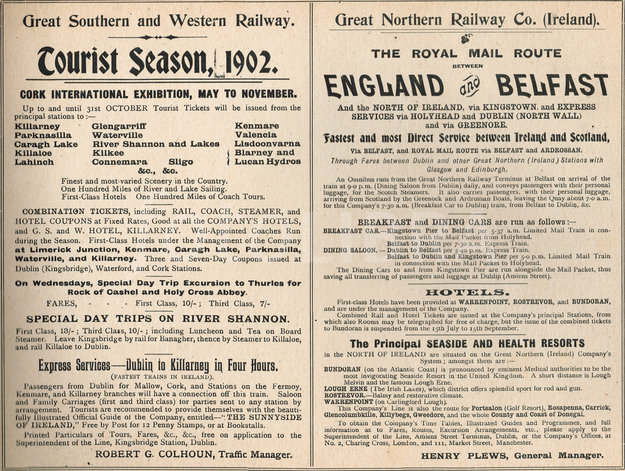
Naturally he asked for the Rightful Owner’s name. It was the Universal Music Group, claiming copyright on the image.
Why? UMG had done a search for GNR and issued take down notices for every image they could find which had GNR in the keywords.
Yes, but why? I did a Google search for GNR and found this:
- GNR is the Great North Run — Newcastle Half Marathon
- GNR Motors is a vehicle repair shop in the Midlands
- GNR are one of the UK’s leading IT distributors
- GNR is an abbreviation for the elderly American pop group Guns N’ Roses
The Great Northern Railway (Ireland), the subject of Carton’s image, does not appear high on the Google search list because it closed down in 1958.
But Guns N’ Roses do, and their agents UMG have sedulously trawled the internet to ensure the world ceases and desists from making even the tiniest profit through any association with the group. Their tsunami of threats has flooded to encompass the poor old Great Northern Railway (Ireland), defunct before the Guns N’ Roses singer was even born.
So to avoid the threat of litigation the ecommerce site capitulated and removed the image. Carton objected, and the site demanded that before they would even consider reinstatement he should agree to these conditions :
“a statement by you that you consent to the jurisdiction of the Federal District Court, San Francisco County, California, United States and that you will accept service of process from the person who provided notification described above or an agent of such person;
“a statement by you that, under penalty of perjury, you have a good faith belief that the material was removed or disabled as a result of mistake or misidentification of the material to be removed or disabled.”
Oh, please. These guys simply caved in under corporate bullying. Carton let the matter drop, and the image is now freely available on the fotoLibra site. So now Mr Rose of the Guns N’ Roses beat combo can breathe a sigh of relief that his pockets aren’t being pilfered and go back to being a milkshake duck.
You Might As Well Jump.
Or was that someone else?
Google AdWords
December 13th, 2017
by Gwyn Headley
Managing Director
Like virtually every online business, fotoLibra spends a small fortune with Google AdWords. We’re supposed to be able to target our market with laser-like precision.
Our market is picture editors, picture researchers and picture buyers, the only segment of the population who never use Google searches, or so it would seem.
We’ve been on Google AdWords courses to work out how best we can deploy this undoubtedly potent tool to best advantage, and we’ve learned about Negative Keywords, and the Search Terms which trigger clicks to our website, and lots of other hard stuff.
fotoLibra has a fairly simple business premise: we license image rights. So all we have to do is to tell people that’s what we do and that we have over a million wonderful images for them to choose from. They’ll flock to us.
Recently we checked our Search Terms. This lets you see precisely what people type before they get shown our ads, and when they click on them, we get billed.
As Google says:
With the Search terms report, you can see the actual searches people entered on Google Search and other Search Network sites that triggered your ad and led to a click.
We were confounded by the information we discovered. 56% of the Search Terms which led people to click on our AdWords contained one or more of the following key words:
sexy
porn
sex
nude
We’re not prudes, but fotoLibra is emphatically not a porn site. Yet there are desperate young men so mad with lust that they are tracking down staid old us to get their jollies.
And we’re paying for it. Each convulsive click they made cost us money that we have to send to Google. It’s all rather sordid.
What can we do about it? Two things. OK, three. Immediately we can add those four words to our Negative Keywords list. We have 282 Negative Keywords which we don’t want to see in a search query, including such obvious candidates as cheap, free, jobs, intern, liquidation, resumé, CV, remainder, discount, HR, recruiter and so on. If you do a Google search and use one of those 282 words, our ads shouldn’t appear. It never occurred to us that some people had no idea how to find porn without involving fotoLibra.
The second and sadder discovery was that 94% of these clickers came from just two countries: India and Pakistan; to be accurate 29% from Pakistan and 65% from India. We can’t remember the last time we actually licensed an image to India or Pakistan so there’s a simple solution — block those countries.
So there’s an end to it. No more fotoLibra ads will appear on Google searches made in Pakistan or India, or when using any of those four words.
But what a tragic world we live in, when Indian and Pakistani men have little better to do than click one-handed on an innocent fotoLibra ad.
Homage to Catalonia
October 3rd, 2017
by Gwyn Headley
Managing Director
Like most decent companies, fotoLibra is apolitical, so we’re not making a political point here. We’re just saying that history repeats itself, or as George Santayana wrote ‘Those who cannot remember the past are condemned to repeat it.’
I have a book published in the 1960s titled ‘Queen Victoria’s Little Wars’ which clearly demonstrated the futility of going to war in Afghanistan. We never learned.
Now fotoLibra contributor David Carton has pointed out this image of Tragic Week on fotoLibra:
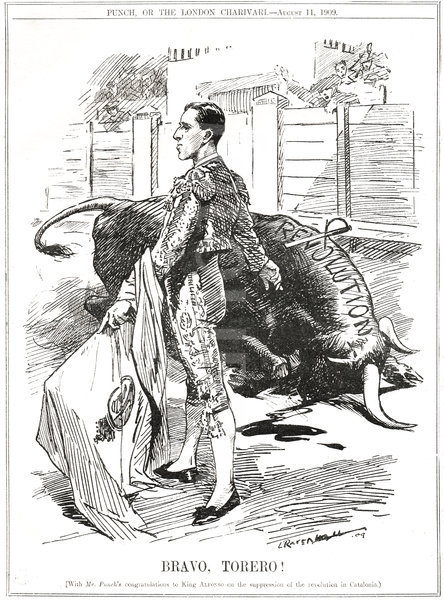
FOT1482477
This is a Punch cartoon congratulating King Alfonso XIII of Spain for brutally putting down a Catalan revolt in 1909.
This week representatives of King Felipe VI of Spain brutally put down a Catalan plebiscite in 2017.
Tragic Week was the name used for a series of violent confrontations between the Spanish army and Catalonian radicals during the last week of July, 1909. Civil guards and police shot at demonstrators in Las Ramblas, resulting in the proclamation of martial law. The Spanish government sent in the army. Barcelonan troops refused to shoot their fellow citizens and so troops were brought in from outside; they put down the revolt after killing dozens of people. General European condemnation was immediate, unlike in 2017.
We never learn.
But we have learned that however tragic the news, there’s probably something in the fotoLibra archive that referenced it years ago.
SSL Certificates
September 14th, 2017Firstly, many apologies for the lack of fotoLibra service over the past few days. The good news is that everything is now back up and running as it should be.
The problem was with our SSL Certificate. An SSL Certificate is a cryptographic protocol that provides security over a computer network. Websites use SSLs to secure communications between their servers and web browsers. Without a valid SSL Certificate you wouldn’t be able to access a website — unless you ignored a string of increasingly dire warnings.
We have automatically renewed our SSL Certificate every two years for the past fourteen years. This year we paid for the renewal on August 25th. Unfortunately our service provider 123-Reg changed their certifying authority from Globalsign to an American company, without notifying us. An email from this unknown new company, Starfield Technologies, demanding sensitive corporate data, went straight into trash.
When we eventually checked with our service provider we were told the email wasn’t spam, it was actually from a legitimate company, despite its very iffy write-up in Wikipedia. In order to verify our SSL Certificate Starfield demanded from us a letter of attestation signed by a lawyer, and an invoice from an outside supplier verifying our telephone number.
How many invoices do you get with YOUR telephone number printed on them? Right — just one, if any; from your phone supplier; BT in our case.
The American company rejected the bill from BT because they had made it out to VisCon Pro Ltd, not to fotoLibra’s holding company VisConPro Ltd. An errant space was sufficient for disqualification.
They rejected our letter of attestation because it was signed by a solicitor, not a lawyer. Americans, eh?
They were not at all interested in the fact that all our corporate data is freely available from Companies House, presumably because Companies House is not yet totally under American control.
Because these verification letters did not meet their demands, this foreign company had the ability to pull the plug on our certification. And so they did. Despite their failure to comprehend our valid credentials, they ensured we were unable to trade for five days.
Do we get recompense? Maybe, if we had phalanxes of highly trained American lawyers. But we don’t.
So once again, please accept our apologies for this downtime. I hope it won’t happen again.
A Picture Library Charging For Pictures? Whatever Next?
August 31st, 2017The estimable Photo Archive News tells us that Hong Kong has realised what other goodly states and countries have been ignoring over the past few years — that photographs actually have a value.
The last twenty years has been the most disruptive period in the image business since the invention of photography. The total transition from film to digital has been virtually completed, the consolidation of almost all picture libraries and stock agencies (except for fotoLibra) has taken place under the Getty hegemony, and prices for images have plummeted, benefitting only publishers — certainly not photographers, illustrators or consumers. Sales of illustrated books — an entire industry — have collapsed.
Now the Hong Kong Government has opened up its archives and decided to charge for its pictures. Is this the carrot at the end of the tunnel? Could we be seeing a reassessment of the value of images? Will people now begin to realise that pictures aren’t free by default?
They write: ‘The Hong Kong Photo Library‘s oldest record can be traced back as early as the mid-1800s. Apart from providing an official photographic record of Hong Kong’s progress and development, the Library includes a treasure trove of photos showing the many and varied facets of life in Hong Kong including our natural beauty, culture, sports and architecture.’
Members of the public can browse their website and view photo records. Hi-res digital photos can be bought for personal or educational use. A handling fee of HK$61 (£6) per photo applies. Photos purchased for commercial use are subject to an additional copyright/commercial use fee of HK$1,000 (£100) per photo.
It’s not a lot. But it’s a start.
Good for Hong Kong. As it says on the lid of my computer: “Pictures can be cheap. The right image is PRICELESS.”
BOO-HOO
July 4th, 2017I don’t want you to think I’ve got a fixation about this, but I believe that photographers are undervalued and underpaid.
And who’s to blame for this? Why, photographers of course.
Once upon a time every branch of every bank had a bank manager. He (always he) would look after your money, let you take some of it out, and very occasionally, after terrifying scrutiny, he may have allowed you a loan.
And once upon a time photographers would sign up with picture libraries, who would license their pictures to publishers and advertisers etcetera and pay them half the net sales receipts.
Then some clever clogs in banking introduced the concept of Products. No longer content with banking your money, they now wanted to sell you Insurance and ISAs and Credit Cards and Loans and Investments and Mortgages and PPI and God knows what else. At the moment my bank offers six different current accounts. And the bank manager is no more.
The same thinking infected the Picture Library business. Instead of simply managing photographer’s image rights, they introduced Royalty Free images and Fixed Prices irrespective of usage and Microstock and Subscription Packages and Credits until the poor photographer no longer knew which way was f22.
The microstock concept was irresistible. Pile ’em high, sell ’em cheap. They sold in their millions — who wouldn’t buy a picture for a dollar, even if you had to spend ten dollars and buy nine pictures you didn’t need to get there? Photographers flocked to upload their images, with sales coming every month instead of once or twice a year. No worry that the sales were in cents and pence rather than dollars and pounds — someone out there liked my picture!
Now that happiness has been tempered. It’s great to make a sale, and it’s fantastic that your photograph has been seen by 40,000 people. Or 400,000. Or 4 million.
But when your photograph has been seen by 400 million people and you’re looking at a cheque for a measly £18 you might feel a little short-changed. But that’s what you signed up for. Brexit means Brexit. Royalty-free means Royalty-free. Microstock means micro-earnings — for the photographer.
The pleasure of seeing your work published palls after you realise everyone else involved is staggering to the bank under the weight of sackfuls of cash.
This has come about because a number of excellent photographers have been shocked to find the beautiful images which they uploaded to microstock sites, full well knowing the prices that would be charged, were actually sold to professional picture buyers. I wonder what they expected?
What they expected was a few pence per image and lots of sales. What they got was something like £18 per picture, and exposure to 400 million people who are using Windows 10. But no picture credit.
Yes, the canny purchaser was Microsoft. If there are photographers out there prepared to offer their work for peanuts, then pay them peanuts. No matter that Microsoft turned over $85,320 MILLION last year. Why pay more if it’s being offered so cheaply?
I can’t say that had Microsoft come browsing around fotoLibra we’d have made millions for our contributors. I can safely say we would have charged much, much more and I believe Microsoft would have been happy to pay it. We’ve sold half-a-dozen images to Microsoft’s excellent search engine Bing and they paid us £175 each.
What’s the answer? Don’t undervalue your work. Put it with an agency that respects your value and your worth. You may not see sale notifications quite so frequently, but when they do come in they’re in pounds rather than pence.
Source material came from Journalisten and PetaPixel, with thanx to Petax Howl.
fotoLibra on Instagram
April 28th, 2017fotoLibra‘s Home Page images have always been a source of joy to picture buyers and general browsers alike.
We’ve had only one lingering worry. Because computers have horizontal screens, all our chosen images had to be Landscape.
And we’ve got just as many superb Portrait images, which we couldn’t show you.
Then we thought, hey, Instagram works well on mobiles and cellphones and tablets, and people tend to hold those things in vertical mode, so why don’t we upload some of our great Portrait format images to Instagram?
Good plan, we thought, patting ourselves on our shapely backs. So here goes. The first one went up earlier this week. Because it won’t click through to the fotoLibra site, each one will be credited as follows:
“Film helicopter: Snow White and the Seven Dwarfs by Kevin Fitzmaurice-Brown. You can licence this image and millions more through fotoLibra.com. #fotoLibra”
Of course they won’t all be photos of Film helicopter: Snow White and the Seven Dwarfs by Kevin Fitzmaurice-Brown. There’ll be a different picture every day, probably including one of yours at some stage. But each image will finish “You can license this image through fotoLibra.com.”
So please go to Instagram, search for fotoLibrarian, and please LIKE every picture you see!
A word of comfort: each image will be small size, lo-res and watermarked so ongoing opportunities for illegal usage have been minimised.